

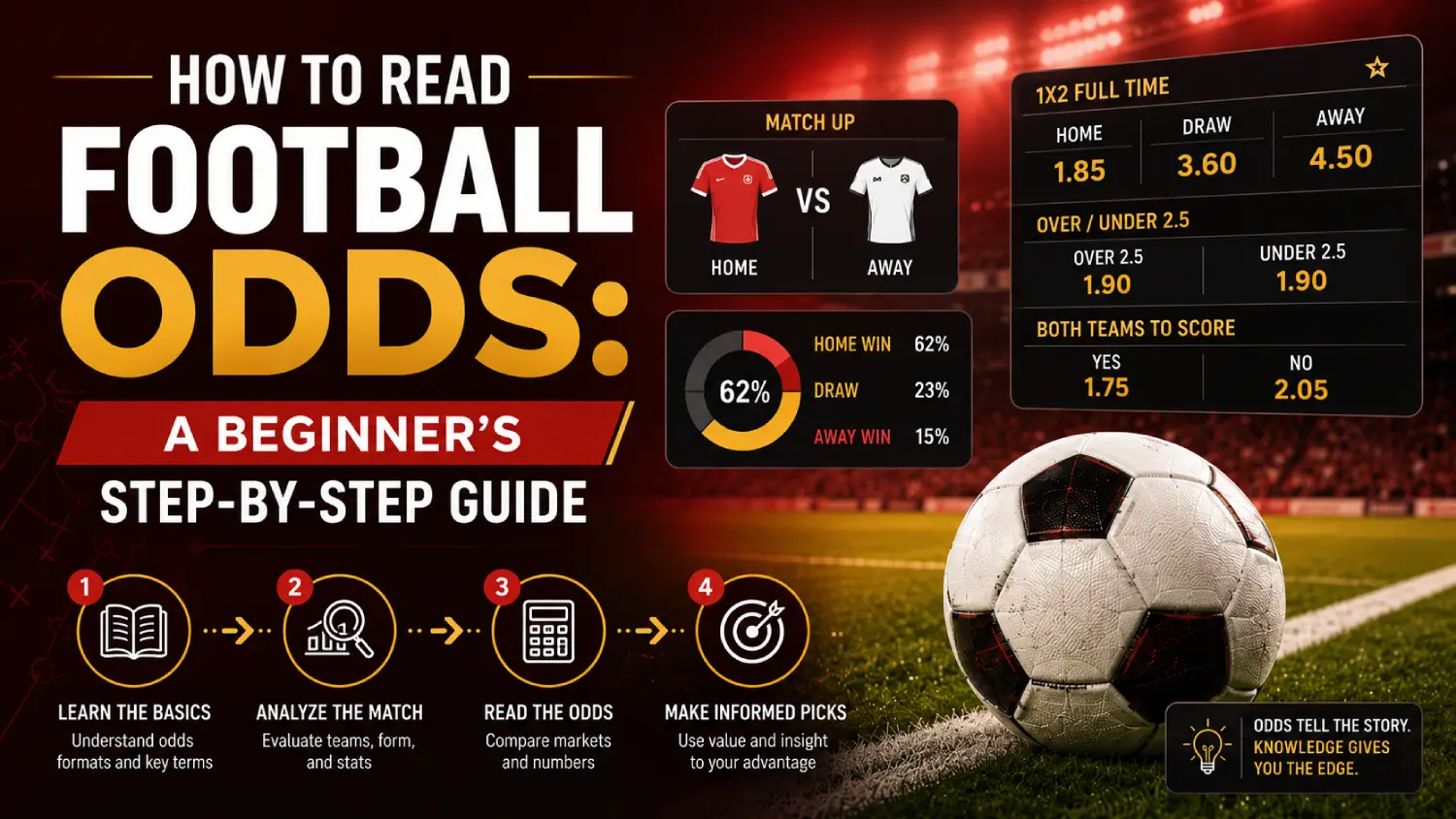
If you’ve ever looked at numbers like 2.10, 3.50, or 5/2 next to a match and felt lost, this guide is for you. Learning how to read football odds takes about ten minutes, and once it clicks, you’ll never look at a match preview the same way again.
This is a complete beginner’s walkthrough. No jargon dumped on you, no assumed knowledge — just a clear, step-by-step path from “I have no idea what these numbers mean” to “I can read any odds and work out my payout in my head.”

Step 1: Understand What Odds Actually Tell You
Before any math, grasp this one idea: football odds tell you two things at once.
- How likely an outcome is. A small number means the outcome is likely. A big number means it’s unlikely.
- How much you’d win. The bigger the number, the bigger the payout — because you’re backing something less likely to happen.
So when you see a strong team at 1.40 and the underdog at 7.00, the odds are telling you the first team is heavily favoured (likely, small payout) and the second is the long shot (unlikely, big payout).
That’s the whole concept. Everything else is just learning the formats.
Step 2: Learn Decimal Odds (The Easiest Format)
In India and most of Europe, odds are shown in decimal format — and it’s the simplest to read. The number tells you your total return for every ₹1 you stake, including your stake back.
The formula is just multiplication:
Total Return = Your Stake × The Odds
Let’s read a few examples with a ₹100 stake:
| Odds | What it means | ₹100 returns | Your profit |
|---|---|---|---|
|
1.50 |
Strong favourite | ₹150 |
₹50 |
|
2.00 |
Even money | ₹200 |
₹100 |
|
3.50 |
Underdog | ₹350 |
₹250 |
|
7.00 |
Long shot | ₹700 |
₹600 |
The one rule to memorise: odds of 2.00 mean you double your money. Anything below 2.00 is a favourite (smaller payout). Anything above 2.00 is an underdog (bigger payout).
That single anchor point lets you instantly judge any price you see.
Step 3: Work Out Your Profit (Not Just Your Return)
The decimal number includes your stake back, so to find profit only, subtract 1 from the odds before multiplying:
Profit = Your Stake × (The Odds − 1)
Example: ₹500 staked at odds of 2.40.
- Profit = ₹500 × (2.40 − 1) = ₹500 × 1.40 = ₹700 profit
- Total return = ₹700 profit + ₹500 stake = ₹1,20
Practise this with a few prices and it becomes automatic.
Step 4: Read Probability Straight From the Odds
Here’s the skill that turns you from a beginner into someone who actually understands betting. Any odds can be flipped into a percentage chance:
Chance (%) = (1 ÷ The Odds) × 100
| Odds | Implied chance |
|---|---|
|
1.50 |
about 67% |
|
2.00 |
exactly 50% |
|
3.00 |
about 33% |
|
5.00 |
exactly 20% |
So when you see a team at 1.50, the odds are saying it has roughly a 67% chance of that outcome. This is how you read what the bookmaker really thinks about a match — not just the payout, but the probability behind it.
Step 5: Recognise the Other Two Formats
You’ll mostly use decimal, but you should be able to read these when you see them.
Fractional odds (like 5/2)
Common in the UK. These show profit only, relative to your stake.
- 5/2 means: win ₹5 for every ₹2 you stake.
- Stake ₹100 → win ₹250 profit, plus your ₹100 back.
- To convert to decimal: divide the fraction and add 1. So 5/2 = (5 ÷ 2) + 1 = 3.50.
American odds (like +250 or −150)
Common in the US, shown with a plus or minus sign.
- +250 → win 250 profit on a 100 stake (an underdog).
- −150 → you must stake 150 to win 100 (a favourite).
Most betting apps let you switch the display format in settings. Set it to decimal while you’re learning.
Step 6: Read a Full Match Card
Now put it together. Here’s how a typical Match Result line looks:
| Outcome | Odds | What it tells you |
|---|---|---|
|
Home win |
1.80 |
Favourite — about a 56% chance |
|
Draw |
3.60 |
Less likely — about a 28% chance |
|
Away win |
4.50 |
Underdog — about a 22% chance |
Reading this card, you instantly know: the home team is favoured, a draw is the second most likely result, and an away win is the long shot with the biggest payout. You can read any match in seconds now.
One thing to notice: add those percentages up (56 + 28 + 22) and you get 106%, not 100%. That extra 6% is the bookmaker’s built-in margin — the small edge the house keeps on every market. It’s normal, and it’s why comparing prices across different sources is worthwhile.
Quick Reference Cheat Sheet
Keep this handy until it’s second nature:
| You want to know… | Use this |
|---|---|
|
Total return |
Stake × Odds |
|
Profit only |
Stake × (Odds − 1) |
|
Chance as a % |
(1 ÷ Odds) × 100 |
|
Is it a favourite? |
Odds below 2.00 = favourite |
|
Is it an underdog? |
Odds above 2.00 = underdog |
|
Fractional → decimal |
(top ÷ bottom) + 1 |
Frequently Asked Questions
How do you read football odds for beginners? Start with decimal odds. The number is your total return per ₹1 staked. Odds of 2.00 double your money; below 2.00 is a favourite, above 2.00 is an underdog. That’s 90% of what you need.
What do odds of 2.00 mean in football? They mean even money — a 50% implied chance. A ₹100 stake returns ₹200, so you double your money if it wins.
How do I calculate my winnings from football odds? Multiply your stake by the decimal odds for your total return. To find profit only, multiply your stake by the odds minus one.
What do the numbers in football odds mean? They show both probability and payout. A low number means a likely outcome with a small payout; a high number means an unlikely outcome with a big payout.
Is a lower or higher number better in football odds? Neither is “better” — they mean different things. Lower odds are more likely to win but pay less; higher odds are less likely but pay more. The right choice depends on the value you see in the price.
A Final Note on Betting Responsibly
Reading odds well helps you understand probability — but it won’t make betting profitable in the long run. The bookmaker’s margin means the house always holds an edge, and most bettors lose over time.
Only ever stake money you can afford to lose, set a budget before you start, and never chase losses. Betting laws vary by state in India, so check what applies where you live. If betting stops being fun, free and confidential support is available through responsible-gambling helplines.
This guide is for informational and educational purposes only and is not betting advice. Please gamble responsibly.