

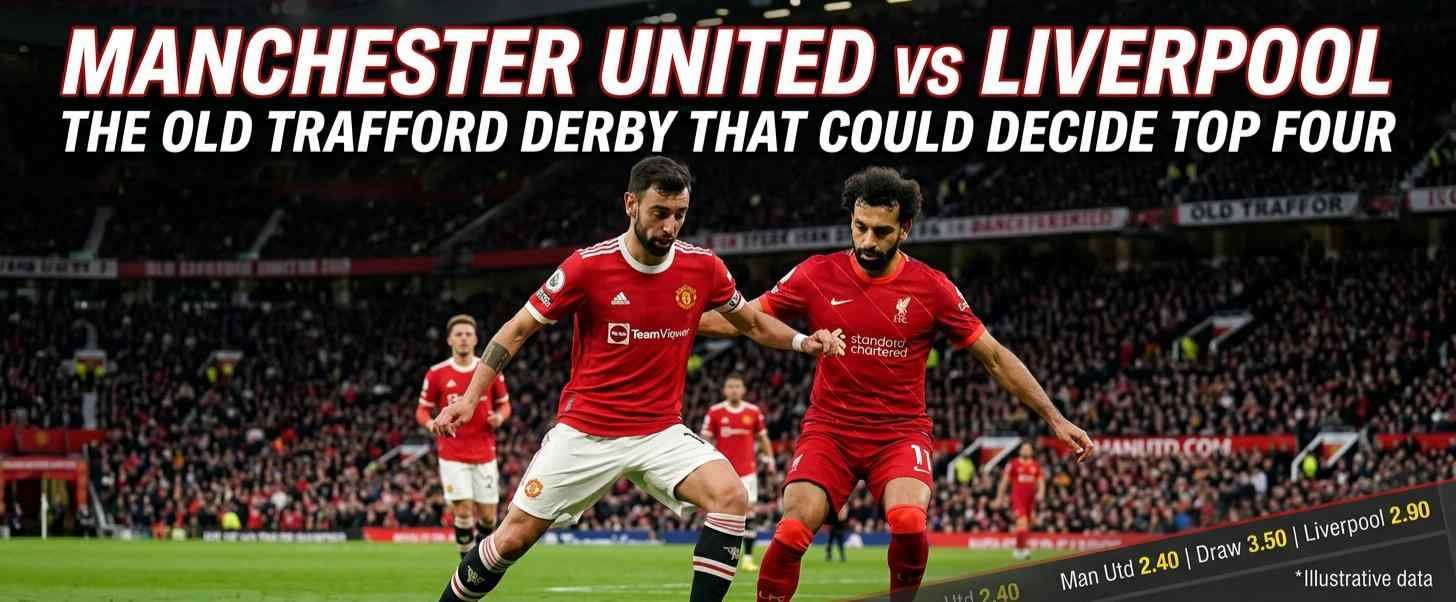
When the fixture list dropped last August, the May 3 meeting at Old Trafford looked like a footnote. Manchester United were entering Ruben Amorim’s first full season with the deepest-rooted problems in the division. Liverpool, fresh off their league title, was the team everyone else was chasing. Eight months on, almost nothing about that picture has held. United arrive third in the table on 61 points. Liverpool arrive fourth on 58. Three points separate them. Four games remain. The North-West derby has, somehow, become the single most consequential fixture of the Premier League run-in.
Quick-reference fixture details
Match: Manchester United vs Liverpool
Competition: Premier League 2025-26, Matchweek 35
Venue: Old Trafford, Manchester
Date: Sunday, May 3, 2026
Kick-off: 4:30 PM IST (4:00 PM BST)
Live in India: Star Sports Network, JioHotstar
League position going in: Manchester United 3rd (61 pts), Liverpool 4th (58 pts)
Reverse fixture: Liverpool 1-2 Manchester United (October 19, 2025, Anfield)

Old Trafford, 4:30 PM Sunday — what’s actually at stake
The headline number is straightforward. United sit third on 61 points after the 2-1 home win over Brentford on April 27. Liverpool is fourth on 58. Aston Villa shares that 58-point total in fifth on inferior goal difference. Brighton, Bournemouth, Chelsea, Brentford, and Fulham are all clustered behind, none yet eliminated from the European places. The top four cushion is real, but it’s not comfortable, and a Liverpool win at Old Trafford collapses it entirely — three points and the head-to-head tiebreaker, with United still to face Manchester City and Arsenal in the closing weeks.
For Liverpool, the calculation is simpler still. Three points keep the Champions League dream alive on their own terms. Anything else and they’re depending on Aston Villa slipping, on Brighton failing to find a final gear, on the kind of late-season chaos that rarely arrives when you need it. Slot’s side has been the better team across most metrics this season. They’ve also been the team that cannot stop losing the matches that matter — Crystal Palace away, Chelsea away, Brentford away, that astonishing October day at Anfield when United won 2-1 with a backs-to-the-wall performance that nobody saw coming.
That October result is the lens through which everything about Sunday gets viewed. United has done this before. They’ve done it this season. The question is whether they can do it again, on the back of the momentum that didn’t exist six months ago.
How Carrick changed the United story
The Amorim era ended in January. The 3-4-3 system that was supposed to be the future of Manchester United had instead produced the worst points-per-game return of the Premier League era for the club, a winless run that swallowed November and December, and a dressing room visibly uncertain of what it was being asked to do. The board moved. Michael Carrick, the academy graduate and former club captain, was handed the interim job until the end of the season.
Carrick’s brief was modest: stop the bleeding, restore some baseline competence, get the club through to summer without Champions League qualification disappearing entirely. What he’s done is significantly more ambitious. United have lost just three league games under his stewardship. They’ve moved from mid-table drift into outright top-four contention. The 4-2-3-1 shape Carrick reverted to has given Bruno Fernandes a free role he hadn’t held in two years, allowed Casemiro to anchor in front of the defence rather than being asked to cover wide channels he can no longer reach, and given the front line a structure that creates clear chances rather than relying on individual moments.
The numbers tell that story. United averaged 1.6 goals per game across the season, but that figure is heavily weighted by a poor first half. The Carrick months have run closer to 1.9. The expected goals against have dropped sharply. The clean-sheet rate has nearly doubled from where it sat at Christmas. There is no honeymoon left to explain this — Carrick has been in charge for nearly four months. The improvement is real, and it’s structural rather than emotional.
The Liverpool side Slot has built
Liverpool’s season has the strange shape of a team that is mostly very good and occasionally terrible. The defensive numbers are the best in the league outside the top two: 1.0 goals conceded per game, 41% clean sheets, midfield pressing structures that have held up against every elite attack they’ve faced. The attacking numbers — 2.0 goals per game, 2.1 xG, 61% average possession — would be sitting comfortably top-four in any normal season. The problem has been the gaps. The Crystal Palace defeat in September. The Chelsea away loss in October. The Brentford defeat in October that nobody has really been able to explain. Manchester United lost at Anfield, which was the worst of them because the performance gap was so visible.
Mohamed Salah remains the central figure. His goal output has dropped from the title-winning season, but his role hasn’t — he is still the player Liverpool funnel everything toward in the final third, still the player opposition managers spend their team meetings trying to neutralise. Hugo Ekitike has settled into the centre-forward role with a kind of physical presence Liverpool haven’t had since Diogo Jota’s prime. The midfield three rotates depending on the opponent, but the spine — Van Dijk, the holding midfielder, and Salah — is what makes this team function.
The injury question matters here. Ekitike picked up a knock in Liverpool’s last outing before being passed fit on international duty for France. Slot will know by Saturday morning whether he’s available. If he isn’t, Liverpool’s options drop sharply, and the prospect of Old Trafford without a focal point in attack is exactly the kind of situation Carrick’s defence will look to exploit.
The tactical key: where this game gets won
The October fixture at Anfield was decided in two phases. United absorbed a 38-minute Liverpool spell where they barely touched the ball, conceded nothing, and then hit Slot’s side twice on transitions when the press got loose. The blueprint Carrick is bringing to Old Trafford is almost certainly the same one. Sit deep through the opening period. Force Liverpool to play through compact lines. Wait for the moment when Van Dijk steps up and the channels behind the full-backs open.
For Liverpool, the answer needs to be patience. They have the ball-retention quality to hold long spells of possession. The temptation will be to force the issue early — to chase the goal that puts United in a hole — but that’s exactly the situation Carrick wants. Slot’s task is to keep his team disciplined for 60 minutes, trust that the chances will come, and avoid the kind of midfield over-commitment that gave United their two transitions at Anfield.
The matchup that decides it is Salah against United’s right side. Diogo Dalot has been one of Carrick’s most reliable performers this season, but Salah remains the matchup nightmare he’s been for years. If Salah has a quiet 70 minutes, Liverpool struggles. If he gets two or three clear isolations against Dalot in the first hour, the game opens up.
The Bruno Fernandes question
Eighteen months ago, Bruno Fernandes looked finished as a top-level player. The Amorim system asked him to play wide, to track back, to cover ground he didn’t want to cover. His numbers collapsed. The narrative that he was a luxury player United could no longer afford had hardened into accepted truth.
The Carrick rehabilitation has been the quietest story of United’s season. Restored to a free role behind the striker, given license to drop deep when he wants the ball, freed from defensive responsibilities he was never going to handle well, Fernandes has produced 17 assists in 29 league games, the highest figure of his United career on a per-game basis. He is once again the player United builds around. Sunday is the kind of fixture Fernandes was made for. Big crowd, biggest opponent, everything riding on a single 90 minutes. The captain’s job is exactly that — captain.
Form, momentum, and the things that don’t show in the table
United have won six of their last eight league games. Liverpool has won four of their last eight. The momentum gap is real, but it’s not as wide as the recent results suggest. Liverpool’s losses have come against teams pressing them aggressively and with pace in transition — exactly the profile of side United have become under Carrick. The Chelsea defeat in October was the template, and Carrick’s team has only gotten better since.
The Old Trafford crowd is the variable nobody can model. The atmosphere for this fixture, with top four on the line and a derby’s worth of grievance built up over the season, is going to be the loudest the stadium has been in years. United’s home record under Carrick is exceptional — six wins from seven league fixtures, with the only dropped points coming in a dead-rubber draw. Liverpool’s away form has been good rather than great. The combination favours United modestly. Not enough to call this a clear edge. Enough to say the home team has reasons for confidence beyond the table.
What to watch for on Sunday
Three things will tell you within 20 minutes how this is going to go. The first is United’s pressing height. Carrick has alternated between mid-block and high press depending on the opponent. If United come out pressing high, they’re trying to win this in the opening half-hour. If they sit deep, it’s the Anfield blueprint, and the game will be played on transitions.
The second is Liverpool’s left-side combinations. Cody Gakpo and the left-back pairing have been Liverpool’s most productive attacking unit when this team is at its best. If those combinations are clicking, Liverpool will dominate the wide areas and force United into the defending shape that eventually cracked at Anfield in October — except this time at Old Trafford with the goal on offer.
The third is the first set piece. Both teams are good in the air. Both teams have struggled defending crosses at various points this season. The first dead-ball moment in either box will tell you which set of defenders is on edge and which has come into the game settled.
The bigger picture
Whatever happens Sunday, this fixture has already done something this season that fixtures rarely do: it has changed the meaning of a derby. The North-West rivalry has spent the past five years being heavily one-sided, with Liverpool the project and United the warning. Sunday’s match arrives with both teams chasing the same prize, with the gap between them measured in three points rather than thirty, with a Manchester United team that has remembered how to play.
That’s the story the Old Trafford crowd will turn up for. Whether it ends in a United win that essentially books their Champions League ticket, a Liverpool win that throws the top four into chaos, or the kind of draw that helps neither side, Sunday at 4:30 is the match that will define the rest of the Premier League season.