
A chase is on. The required rate climbs. The batter at the crease has faced 30 balls for 20 runs. The team needs boundaries. The next 20 balls produce 40 runs. The innings turns. The number that shifted the match is the strike rate.
Strike rate measures how quickly a batter scores. It is runs per 100 balls. The statistic has grown from a secondary metric to a core one. In T20 cricket, it sits alongside the average. In the modern game, it defines a batter’s value.

This guide explains strike rate in cricket. How it works. How to calculate it. How to read it. The limits of the statistic. What it tells you. What it does not.
What Strike Rate Is
Strike rate measures scoring speed. It tells you how many runs a batter scores per 100 balls faced.
The statistic applies to all formats. Test. ODI. T20. The benchmark shifts. The calculation stays the same.
Strike rate in cricket has always existed. The early records tracked it. But it sat behind the batting average in importance. The modern game changed that. T20 cricket made scoring speed the primary currency.
The number is simple to read. A higher strike rate means the batter scores faster. A lower strike rate means the opposite. Cricket terminology treats this as a key batting metric. Sports statistics place it alongside the average for modern analysis.
The statistic captures intent. A batter with a high strike rate looks to score. A batter with a low strike rate looks to survive. Both roles matter. The strike rate tells you which role the batter plays.
Explore More: Dafabet-Dafabet App Download Made Easy: Android & iOS Installation Guide
The Formula Explained
The formula for batting strike rate is straightforward.
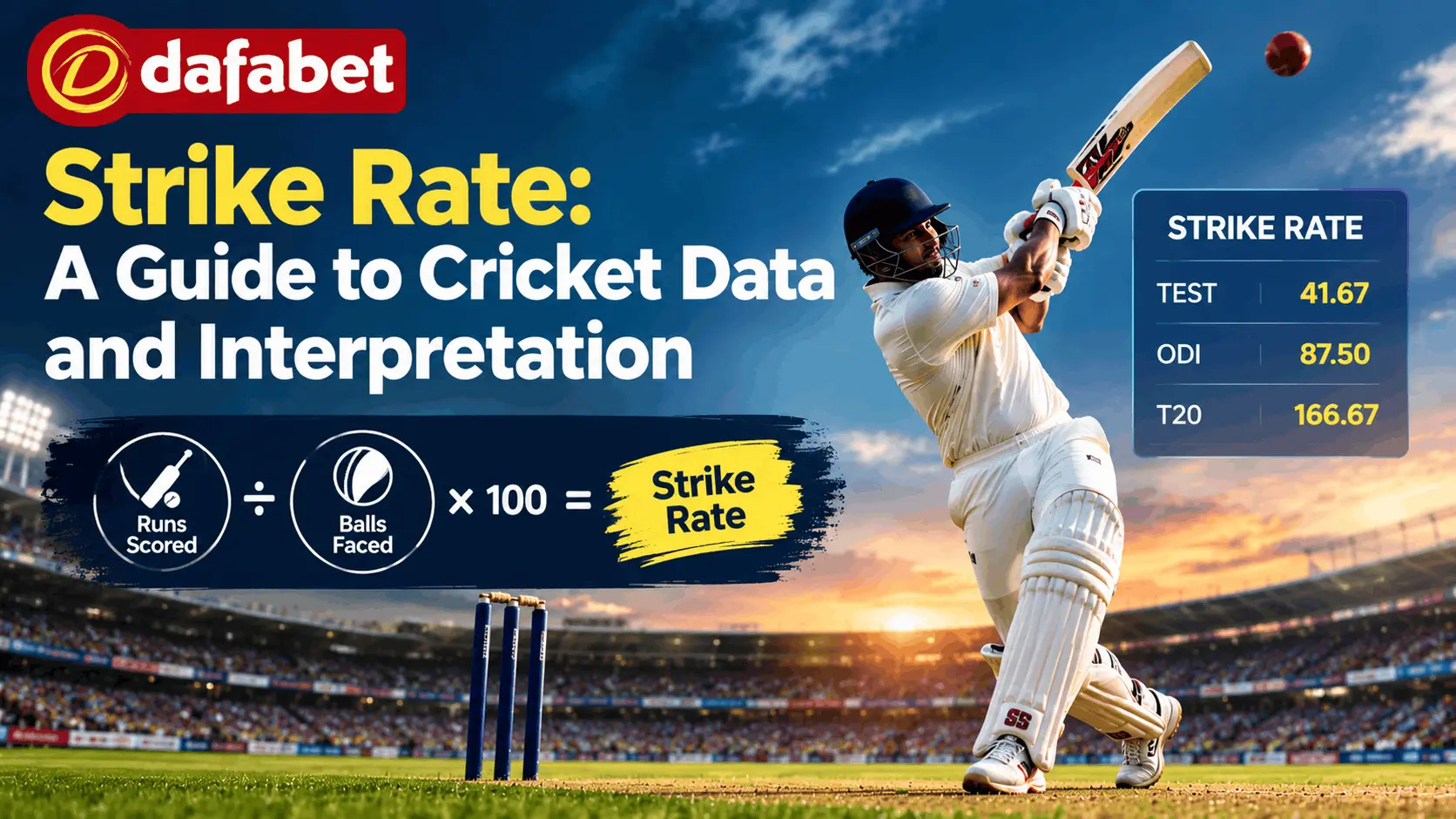
Strike Rate = (Runs Scored ÷ Balls Faced) × 100
The result is expressed as a number. 100 means a run a ball. 150 means 1.5 runs per ball. 50 means a run every two balls.
The key detail is the multiplier. Without it, the result would be a decimal. The 100 converts it to a readable number. A batter who scores 50 off 40 balls has a strike rate of 125. A batter who scores 50 off 60 balls has a strike rate of 83.33.
Balls faced includes every delivery the batter faces. Dot balls. Singles. Boundaries. Wides do not count as balls faced. No-balls do not count either. Cricket rules define which deliveries count. The statistic respects the definition.
A Worked Example
Take a batter in a T20 chase. They score 75 runs off 45 balls. The calculation is (75 ÷ 45) × 100 = 166.67. The strike rate is 166.67.
That is a fast innings. The batter scores at 1.67 runs per ball. In T20 cricket, a strike rate above 150 is strong. Above 180 is exceptional.
Now take a batter in a Test match. They score 75 runs off 180 balls. The calculation is (75 ÷ 180) × 100 = 41.67. The strike rate is 41.67.
That is a patient innings. The batter scores at 0.42 runs per ball. In Test cricket, a strike rate in the 40s is common. The format rewards time at the crease.
The two innings produced the same runs. The context changed the value. The strike rate captures the difference. The T20 innings pushed the scoring. The Test innings absorbed pressure.
What a High Strike Rate Tells You
A high strike rate means the batter scores fast. Boundary hitting. Quick running. Aggressive intent.
The batter looks to dominate the bowling. They take risks. They attack the loose ball. They convert good balls into singles. The pressure shifts to the bowler.
Player performance is tied to this in T20. A batter with a high strike rate is a match-winner. The team can post big totals. The chase becomes easier. The required rate stays under control.
In ODI cricket, the strike rate matters through the middle overs and the death. A batter who scores at 100-plus keeps the innings moving. A batter who scores at 70 drags the total down.
In Test cricket, the strike rate still matters. But the value shifts. A batter with a high strike rate can change the game quickly. A batter with a low strike rate can bat the opposition out of the match. Both roles have value.
What a Low Strike Rate Tells You
A low strike rate means the batter scores slowly. Defensive play. Time at the crease without scoring.
This is not always a negative. A Test opener facing a new ball on a seaming pitch may score slowly. The role is to survive. The strike rate is low. The value is high.
The context matters. A top-order batter in T20 cricket with a low strike rate is a problem. The team loses momentum. The required rate climbs.
The role shapes the expectation. A Test anchor is judged on time at the crease. A T20 finisher is judged on scoring speed. The strike rate reflects the second role better than the first.
What Strike Rate Misses
Strike rate does not tell the whole story. Here is what the number leaves out.
Consistency. A batter with a high strike rate may get out quickly. The strike rate does not measure how long the batter stays in. A 20-ball 40 and a 100-ball 40 have the same runs. The strike rates differ. The first innings may have hurt the team if the batter got out at the wrong time.
Match situation. A slow innings in a low-scoring match may be valuable. A slow innings in a high-scoring match may be a liability. The strike rate treats both the same.
Pitch conditions. A strike rate of 120 on a turning track may be excellent. The same rate on a flat pitch may be below par. The statistic does not adjust for the surface.
Opposition quality. Runs scored against a weak attack count the same as runs against a strong one.
Match analysis uses strike rate as one input. Not the only one. The statistic is a starting point. The context completes the picture.
The limits do not make the statistic useless. They define what it can and cannot do. The strike rate tells you about scoring speed. It does not tell you about consistency. Both matter. The reader needs both.
Strike Rate Across Formats
The statistic varies by format.
Test cricket. Strike rates are usually the lowest. Test matches last five days. Batters face more balls. The format rewards patience. Strike rates in the 40s to 60s are common. A rate above 70 is aggressive.
ODI cricket. Strike rates sit in the middle. 50-over matches give batters time. Strike rates in the 80s to 100 range are common. Elite ODI batters strike above 90.
T20 cricket. Strike rates are the highest. The format rewards aggression. Strike rates in the 130s to 150s are common. Elite T20 batters strike above 150.
The difference matters for interpretation. A strike rate of 130 in Test cricket is exceptional. The same rate in T20 cricket is solid but not elite. The format shapes the number.
The Modern Game: Average and Strike Rate
Modern cricket values both statistics. Batting average and strike rate together tell the full story.
The complete package scores quickly and stays in. High average. High strike rate. These batters are rare. They win matches in any format.
The aggressor scores quickly but risks getting out. Lower average. High strike rate. The role suits T20. The team accepts the risk for the reward.
The anchor stays in without scoring quickly. High average. Lower strike rate. The role suits Test cricket. The team builds the innings around them.
The batter who struggles in every format has neither. Lower average. Lower strike rate. The numbers expose the weakness.
The two statistics are read together. The interpretation depends on the role. The format. The team’s needs.
How to Read Strike Rates
A quick guide to the benchmarks. In Test cricket, a strike rate above 70 signals an aggressive batter. Between 50 and 70 is positive. Between 40 and 50 is standard. Below 40 is slow but often intentional.
In ODI cricket, above 100 is aggressive. Between 85 and 100 is strong. Between 75 and 85 is standard. Below 75 is below par for a modern ODI batter.
In T20 cricket, above 160 is exceptional. Between 140 and 160 is strong. Between 120 and 140 is standard. Below 120 is a concern unless the batter is playing a specific anchor role.
These ranges are guides. They shift with eras. The modern game has higher strike rates across the board. The benchmarks reflect that.
Read More: Dafabet-Dafabet Betting Guide 2026: How It Works, Sports, Odds & Types of Bets Explained
Strike Rate vs Bowling Strike Rate
The term strike rate means two different things in cricket. This is a common source of confusion.
Batting strike rate. Runs scored per 100 balls. Measures scoring speed. A high number is good for the batter.
Bowling strike rate. Balls bowled per wicket taken. Measures how often the bowler takes a wicket. A low number is good for the bowler. A bowling strike rate of 30 means the bowler takes a wicket every 30 balls.
The two statistics measure different things. The batting strike rate is about scoring. The bowling strike rate is about wicket-taking. Both use the same term. The context tells you which one applies.
The bowling strike rate has its own formula. Balls bowled ÷ wickets taken. The result is the average number of balls per wicket. A lower number means the bowler strikes more often. A higher number means the bowler takes longer to break through.
When a commentator says “strike rate,” the context usually clarifies. A batter’s strike rate is the scoring speed. A bowler’s strike rate is the balls per wicket. The two are not interchangeable.
The Bottom Line: A Statistic Worth Understanding
Strike rate explained is simple. Runs per 100 balls. The statistic measures scoring speed. It tells you how quickly a batter scores.
The calculation matters. Balls faced defines the denominator. Wides and no-balls do not count. The distinction shapes the number.
The limits matter too. Strike rate does not measure consistency. It does not capture context. It is one statistic among many. The modern game reads it alongside the average.
Strike rate in cricket has grown from a secondary metric to a core one. It defines the modern batter. Understanding how strike rate works is the key to reading the modern game.