
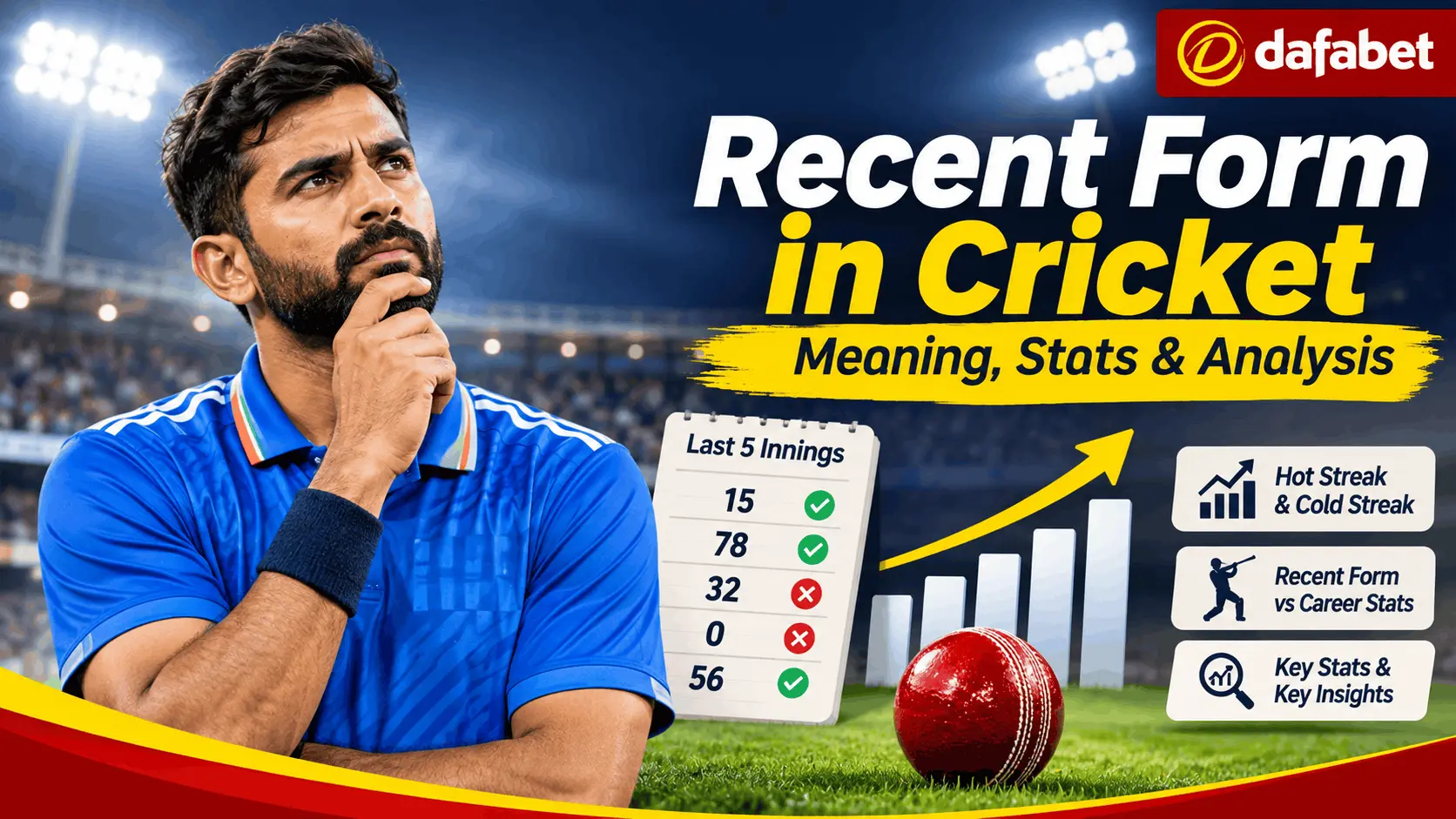
The batter walks out to the middle. The crowd expects a big score. The numbers tell a different story. Three single-digit scores in the last five innings. The bat looks heavy. The feet look slow. The bowler knows it. The fielders know it.
Recent form measures that short-term trend. The last five innings. The last ten matches. The hot streak. The cold streak. The number tells you what the player is doing right now. Not what they did five years ago.

This guide explains recent form in cricket. What it means. How it works. The window. The limits. What it tells you. What it does not.
What Recent Form Is
Recent form measures a player’s performance over a short window. The last few matches. The last few innings. The trend line.
The statistic applies to all formats. Test. ODI. T20. The window shifts. The concept stays the same.
Recent form in cricket has always mattered. Selectors have always watched the last few innings. The modern game added the data. The rolling averages. The strike rate trends. The dismissal patterns. The numbers track the present.
The number is simple to read. A hot streak means the player is scoring. A cold streak means the player is struggling. Cricket terminology treats this as a key selection tool. Sports statistics place it alongside the career numbers for match analysis.
The statistic captures the present. The career average captures the past. The two sit together. The selector reads both.
The Window Matters
The window defines the number. A small window. A large window. The trend shifts with the choice.
The last five innings. The shortest common window. The sample is tiny. One good innings changes the average. One bad innings drags it down.
The last ten innings. The standard window. The sample grows. The trend stabilizes. The numbers carry more weight.
The rolling average. The moving window. The number updates with every innings. The trend line shows the direction. Upward. Downward. Flat.
The window choice matters. A player with two big scores in the last five innings looks hot. The same player over ten innings looks average. The reader checks the window. The window shapes the story.
What a Hot Streak Tells You
A hot streak means the player is scoring. The runs flow. The confidence builds.
The batter finds the middle of the bat. The timing clicks. The feet move. The shots find the gaps. The bowler bowls well. The batter survives. The bowler bowls badly. The batter punishes.
Player performance is tied to this. A player in form is a match-winner. The team builds around them. The opposition plans for them.
The hot streak carries weight in selection. A player in form gets the nod over a player with a better career record. The selectors trust the trend. The present matters more than the past.
Take one example. A batter dropped from the national side returns to domestic cricket. He scores runs. He leads his team to a title. The selectors recall him. The recent form earned the spot.
The hot streak also carries weight in the match. The captain picks the in-form player. The in-form player delivers. The cycle continues.
What a Cold Streak Tells You
A cold streak means the player is struggling. The runs dry up. The confidence drops
The batter misses the middle. The edges fly. The feet stop moving. The bowler bowls well. The batter falls. The bowler bowls badly. The batter still falls
The cold streak carries weight in selection. The selectors drop the player. The reputation does not save the spot. The present matters more than the past.
Take one example. A top-order batter loses form. The selectors drop him. The player goes back to domestic cricket. He rebuilds. He returns. The cold streak ends. The cycle continues.
The cold streak also carries weight in the match. The captain protects the out-of-form player. The player survives. The player fails. The pressure builds.
The Data Behind the Form
The broadcasters track the trend. The analysts track the trend. The numbers sit on the screen.
The last ten innings. The runs scored. The average. The strike rate. The boundary count. The dot ball count.
The dismissal pattern. The mode of dismissal. The caught behind. The lbw. The bowled. The pattern shows the weakness. The bowler targets the weakness.
The scoring zones. The areas where the player scores. The areas where the player struggles. The fielders move. The plans shift.
The ball-by-ball data. The shot selection. The leave. The defence. The attack. The data builds the picture.
The tracking has changed the analysis. The teams use the data. The coaches plan the match-ups. The recent form guides the selection. The old scorecards held the totals. The modern systems hold the detail.
What Recent Form Misses
Recent form does not tell the whole story. Here is what the data leaves out.
The sample size. Ten innings is small. One innings moves the average. The trend flips in one match. The number is noisy.
The opposition quality. Runs against a weak attack count the same as runs against a strong attack. The data does not adjust for the bowler. The number climbs against the weak attack. The trend misleads.
The conditions. A hot streak at home may not survive an away tour. The conditions shift. The form drops. The number does not adjust for the surface.
The luck. A dropped catch. A marginal lbw. The edge that falls short. The luck shapes the numbers. One player admitted luck played a role in his return to form. A dropped catch early in an innings changed the series. The data cannot measure luck.
The mental side. Confidence. Pressure. The mind shapes the form. The numbers do not capture the mental state. The player who looks out of form may be one good shot away from the streak.
Match analysis uses recent form as one input. Not the only one. The trend is a starting point. The context completes the picture.
The limits do not make the metric useless. They define what it can and cannot do. The recent form tells you about the present. It does not tell you about tomorrow. Both matter. The reader needs both.
Recent Form Across Formats
The trend varies by format. The numbers shift. The patterns change.
Test cricket. The window is long. The last five Tests. The last ten innings. The sample is small. The format rewards patience. The form shifts slowly.
ODI cricket. The window is medium. The last five matches. The last ten innings. The sample grows. The format rewards consistency. The form shifts steadily.
T20 cricket. The window is short. The last five matches. The last ten innings. The sample shrinks. The format rewards aggression. The form shifts quickly.
The difference matters for interpretation. A T20 hot streak ends in one match. A Test slump lasts a series. The format shapes the window. The window shapes the confidence.
The player records follow the same pattern. A Test trend covers more balls. A T20 trend covers fewer. The sample size decides the value. The reader checks the volume.
How to Read Recent Form
The numbers are simple. The last ten innings. The runs. The average. The strike rate.
A batting average above 50 in the last ten innings stands out. Between 35 and 50 is strong. Between 20 and 35 is average. Below 20 is a concern.
A strike rate above 150 in T20 stands out. Between 130 and 150 is strong. Below 120 is a concern.
The wickets matter too. A bowler taking 15 wickets in the last five matches is hot. A bowler taking 5 wickets is cold. The numbers tell the story.
The reader checks the context. The opposition. The conditions. The window. The numbers alone do not tell the full story. The context fills the gaps.
Recent Form vs Career Stats
The two measures answer different questions. The distinction matters.
Career stats. The long-term record. The batting average. The bowling average. The numbers measure the player across the career.
Recent form. The short-term trend. The last ten innings. The numbers measure the player right now.
The two work together. The career stats show the level. The recent form shows the trend. A player with a high career average and a cold streak faces a problem. A player with a low career average and a hot streak has an edge.
The modern analysis reads both. The level and the trend. The full picture.
The Bottom Line: A Statistic Worth Understanding
Recent form explained is simple. The performance over the last few matches. The statistic measures the present. It tells you what the player is doing right now.
The data matters. The window. The runs. The wickets. The dismissal patterns. The numbers build the picture.
The limits matter too. The sample size is small. The opposition quality shifts the number. The luck is unmeasurable. The form is one input among many. The modern game reads it alongside the career stats.
Recent form in cricket has grown from a selector’s hunch to a core analysis tool. It defines the modern selection. Understanding how recent form works is the key to reading the modern game.