
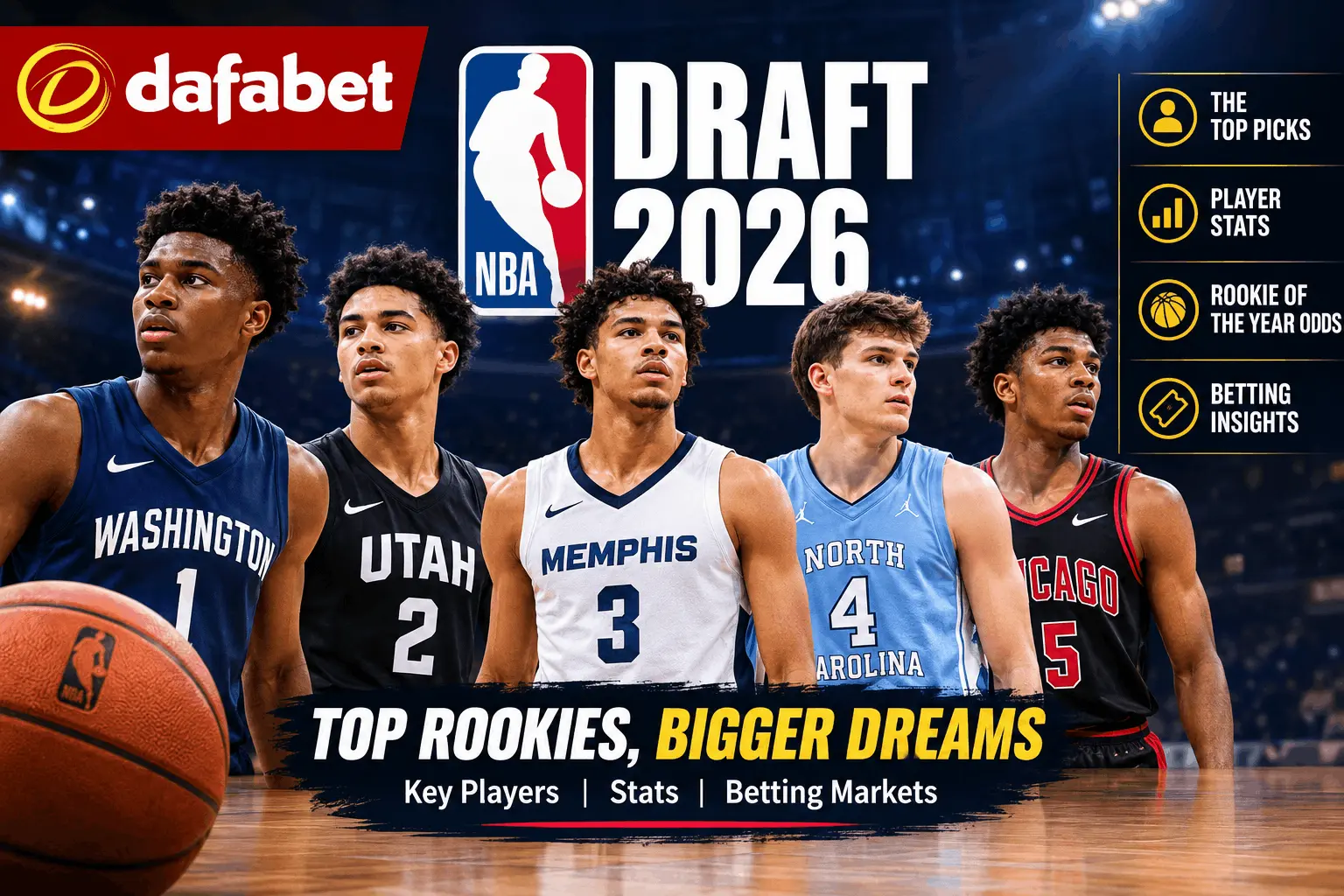
The 2026 NBA Draft delivered a class that scouts have been tracking for years. Nine of the top ten picks were college freshmen. The first twenty selections all played college basketball. This is the deepest rookie group in recent memory.
The top three picks went as expected. AJ Dybantsa to Washington. Darryn Peterson to Utah. Cameron Boozer to Memphis. The story goes deeper than the draft order. Summer League shifted the odds. The Rookie of the Year race is wide open.

This blog covers the names to know. The stats behind the hype. And the betting markets that follow them.
The Draft That Changed the League
The NBA draft 2026 was a college showcase. Nine of the top ten picks came from the NCAA. The first twenty selections all played college basketball.
AJ Dybantsa went first to Washington. Darryn Peterson went second to Utah. Cameron Boozer went third to Memphis. Caleb Wilson went fourth to Chicago. Darius Acuff Jr. went seventh to Sacramento.
The class is deep. Kon Knueppel set the rookie 3-point record last season with 273. Stephon Castle is the frontrunner for Most Improved Player. The bar is high for the new group.
The NBA draft 2026 also produced a clear theme. Teams are betting on youth. Washington, Utah, and Memphis all handed the keys to first-year players. The rebuilds are on.
Explore More: NBA 2026/27 Season: Teams, Storylines And Players To Watch. Football And Cricket
AJ Dybantsa: The No. 1 Pick
Dybantsa averaged 25.5 points at BYU. He led Division I in scoring as a freshman. He won Big 12 Rookie of the Year honors.
In Summer League, he scored 50 points across two games. He averaged 25 points, 7 rebounds, 2.5 steals, and 1.5 blocks. He scored 27 in his debut against the Jazz. Washington shut him down after two games for rest.
The concern: Washington also has Trae Young and Anthony Davis. Dybantsa may be the third option on offense. His counting stats will suffer.
His three-point shot struggled in Summer League. He shot 1-of-11 from deep. His inside scoring and foul-drawing stood out. The jumper is the question mark.
The upside is obvious. Dybantsa is a 6-foot-9 wing with guard skills. He gets to the rim at will. He draws fouls. He runs the floor. If the jumper develops, he is a problem for the next decade.
Darryn Peterson: The Polished Scorer
Peterson averaged 20.2 points at Kansas. He shot 38.2% from three. He broke Andrew Wiggins’ freshman scoring record.
Scouts call him the most polished scorer in the class. He showcased playmaking in Summer League. He averaged 23 points, 5.2 assists, 3.2 rebounds, 1 steal, and 1.2 blocks. He scored 28 in his debut against the Hawks.
The downside: Utah has Jaren Jackson Jr., Lauri Markkanen, Ace Bailey, and Keyonte George. Usage may be limited. Peterson will share the ball.
His mid-range game is already NBA-ready. He creates separation. He finishes through contact. The playmaking was the surprise. Scouts knew he could score. They did not know he could run an offense.
Cameron Boozer: The Favorite
Boozer averaged 22.5 points and 10.2 rebounds at Duke. He won the Naismith Award. He is the son of former NBA All-Star Carlos Boozer.
In Summer League, he posted 18 points, 7.4 rebounds, 3.8 assists, and 1.5 steals per game. He played eight games, the most of any top rookie. In the Summer League championship loss, he posted 19 points, 8 rebounds, 4 assists, and 2 steals.
Memphis is rebuilding. If Ja Morant is traded, Boozer becomes the focal point. High usage and counting stats follow.
Boozer’s game is old-school. He scores in the post. He rebounds on both ends. He passes out of double teams. The modern NBA values versatility. Boozer brings it.
The Sleepers: Wilson, Acuff, and More
Caleb Wilson went fourth to Chicago. He averaged 19.8 points and 9.4 rebounds at North Carolina. In Summer League, he averaged 29.7 points, 7 rebounds, and 3 blocks across three games. He scored 35 in his debut. Yahoo Fantasy ranks him No. 1 in dynasty value.
Wilson’s Summer League was the loudest. He dominated inside. He blocked shots. He ran the floor. Chicago has not had a rookie like this in years.
Darius Acuff Jr. went seventh to Sacramento. He averaged 23.5 points at Arkansas. He is an explosive scorer. Sacramento is rebuilding. If Domantas Sabonis and DeMar DeRozan leave, Acuff gets volume. Summer League was shaky. The usage opportunity is there.
Acuff’s game is built on speed. He gets to the rim. He draws contact. He plays with pace. The jump shot needs work. The rest is there.
Read More: Dafabet: A Complete Guide to a Top Casino Games Site
The Betting Angle: Odds and Value
The Rookie of the Year odds tell a story. Kalshi Sports opened the market after the draft.
Caleb Wilson leads at 26%. Cameron Boozer follows at 20%. AJ Dybantsa sits at 18%. Darryn Peterson is at 17%.
Wilson started Summer League at 10%. He ended it as the favorite. The shift happened fast.
The Rookie of the Year odds will move again before opening night. Preseason games matter. Training camp reports matter. Injuries matter.
The lesson: Summer League matters. Odds move. Bettors who watched the games found value before the lines shifted. Bettors who waited missed the window.
The Rookie of the Year odds also reflect team context. Wilson has the clearest path to minutes. Boozer has the clearest path to usage. Dybantsa has the most competition. Peterson has the most polish.
The Bottom Line: A Class Worth Watching
The NBA rookie class 2026 is loaded. Dybantsa, Peterson, and Boozer lead the group. Wilson and Acuff are closing fast.
The Rookie of the Year race is wide open. Wilson leads the odds. Boozer has the usage. Dybantsa has the talent. Peterson has the polish.
The NBA rookie class 2026 will shape the next decade. The first chapter starts in October.