
The middle order is struggling. Two wickets fall in quick succession. The score sits at 60 for 4. A partnership forms. The two batters settle in. They rotate the strike. They find the boundary. The score climbs to 180. The partnership changed the innings.
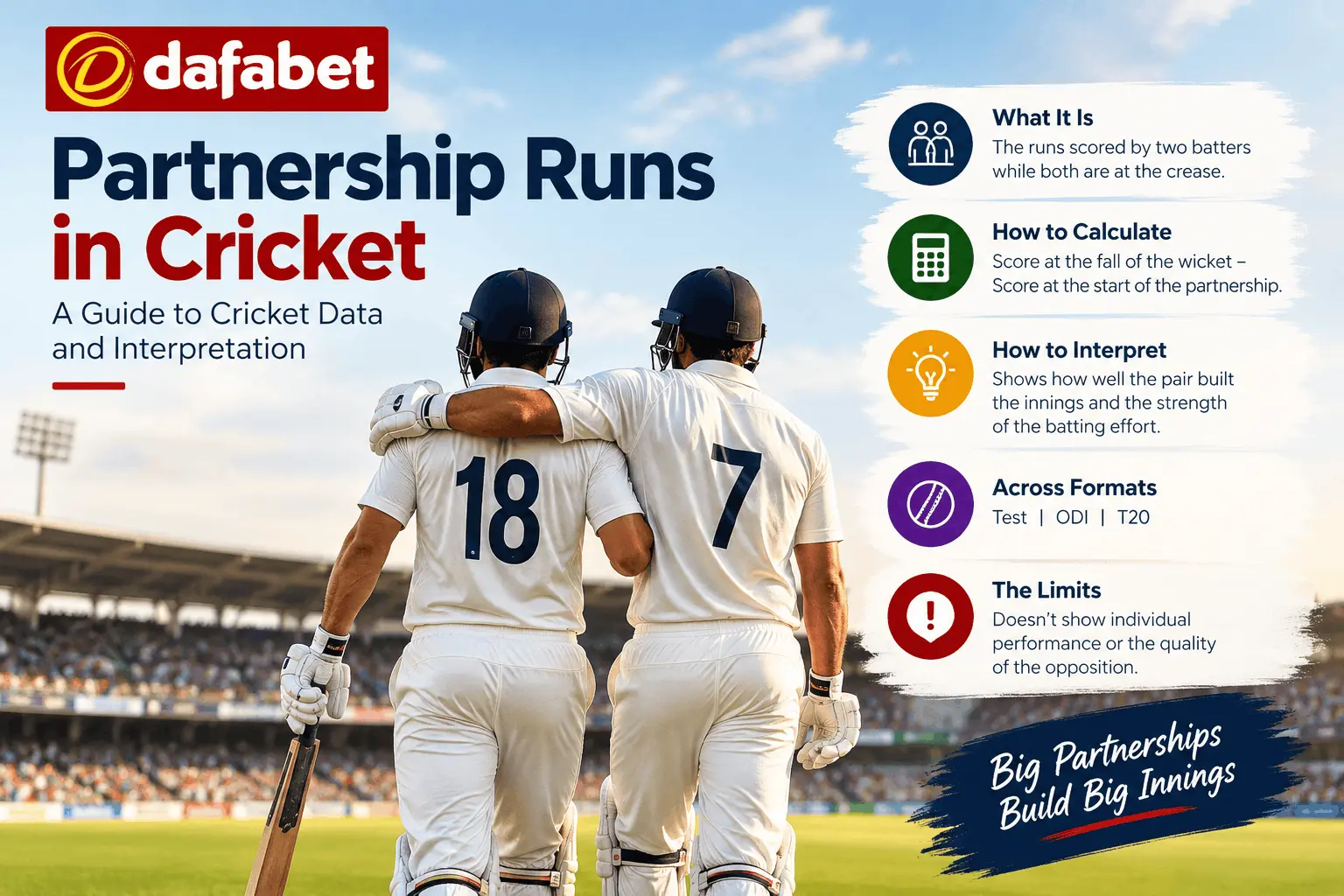
Partnership runs measure how two batters score together. The statistic tracks the runs added while both are at the crease. The number tells you how well the pair built the innings.

This guide explains partnership runs in cricket. How it works. How to calculate it. How to read it. The limits of the statistic. What it tells you. What it does not.
What Partnership Runs Are
Partnership runs measure the runs scored by two batters while both are at the crease. The partnership starts when the two batters meet. It ends when one is dismissed.
The statistic appears in every cricket scorecard. The partnership section shows each pair’s total. The opening pair. The second wicket. The third. Down to the last wicket.
The statistic applies to all formats. Test. ODI. T20. The numbers shift. The concept stays the same.
Partnership runs in cricket have always been tracked. The scorecard records them. The commentators discuss them. The fans remember the big stands.
The number is simple to read. A big partnership means the pair built a strong stand. A small partnership means the bowling attack broke through quickly. Cricket terminology treats this as a core scorecard metric. Sports statistics place it alongside individual scores for match analysis.
The statistic captures the pair. Not the individual. Two batters share the partnership total. The number reflects their combined effort.
The scorecard tracks the partnerships in order. The opening stand. The second wicket. The third. Each pair gets its own line. The totals add up through the innings. The reader can see how the score was built.
Explore More: Dafabet-Dafabet Cricket Betting: A Complete Guide to the App and Markets
How Partnership Runs Work
The calculation is different from the other cricket statistics. There is no division. Partnership runs are a total.
Partnership Runs = Score at the Fall of the Wicket − Score at the Start of the Partnership
The formula has two components. The score when the partnership starts. The score when the partnership ends.
Here is the process.
Step one. Note the team score when the two batters come together.
Step two. Note the team score when the next wicket falls.
Step three. Subtract the first from the second. The result is the partnership.
The calculation runs for each wicket. The opening partnership. The second-wicket partnership. The third. Every pair gets its own number.
The total partnership runs add up to the team’s final score, minus extras and the not-out batter’s contribution. The scorecard tracks each one.
Cricket rules define how the partnership is recorded. The score at the wicket fall decides the total. The rules apply across formats.
A Worked Example
Take a team in an ODI match. Here is how the innings builds.
First wicket. The opening pair scores 45 runs. The score sits at 45 for 1.
Second wicket. The next pair scores 30 runs. The score sits at 75 for 2.
Third wicket. The next pair scores 85 runs. The score sits at 160 for 3.
Fourth wicket. The next pair scores 20 runs. The score sits at 180 for 4.
The third-wicket partnership is the standout. 85 runs. The pair rebuilt the innings. The opening pair scored 45. The second pair scored 30. The fourth pair scored 20.
The totals add up. 45 + 30 + 85 + 20 = 180. The score matches the fourth-wicket fall.
The example shows how partnerships build an innings. Each pair contributes. The big partnership carries the weight.
The other pairs still matter. The opening 45 set the platform. The second-wicket 30 kept the score moving. The fourth-wicket 20 added the final runs before the fifth wicket. Every partnership plays a role.
What a Big Partnership Tells You
A big partnership means the two batters settled in. They rotated the strike. They found the boundary. The bowling attack could not break through.
The pair built the innings. The runs flowed. The score climbed. The pressure shifted to the opposition.
Player performance is tied to this. A big partnership requires two batters in form. One anchors. One attacks. The combination works. The pair covers the strike rate. The pair covers the average.
In Test cricket, a big partnership can bat the opposition out of the match. Two batters stay at the crease for sessions. The score climbs. The bowling attack tires. The draw or the win becomes possible.
In ODI cricket, a big partnership sets the total. A 150-run stand through the middle overs changes the match. The team posts a challenging score. The opposition faces the pressure.
In T20 cricket, a big partnership produces the total. A 100-run stand in 10 overs sets up the innings. The death overs add the finishing touch.
The big partnership also protects the middle order. When the top order fails, the middle-order pair rebuilds. The score recovers. The team stays in the match.
What a Small Partnership Tells You
A small partnership means the batters struggled. The bowling attack dominated. The wickets fell quickly.
The team loses momentum. The run rate drops. The incoming batters face more pressure. The score stalls.
This is not always a disaster. A quick cameo can change the match. A 20-run partnership off 8 balls in T20 cricket is valuable. The strike rate matters alongside the total.
The context matters. A small partnership in a Test match may signal a batting collapse. A small partnership in T20 may be part of the plan.
The role shapes the expectation. A top-order partnership is judged on the runs. A lower-order partnership is judged on the impact.
A string of small partnerships signals trouble. Three wickets for 15 runs. The score stalls. The team faces a rebuild. The middle order carries the pressure.
What Partnership Runs Miss
Partnership runs do not tell the whole story. Here is what the number leaves out.
Individual performance. The two batters share the number. A 100-run partnership may see one batter score 80 and the other score 20. The statistic does not show the split. Individual scores tell that story.
The quality of the bowling. A 50-run partnership against a strong attack counts the same as one against a weak attack. The statistic does not adjust for the opposition.
The pitch conditions. A 50-run partnership on a turning track may be worth more than 80 on a flat pitch. The statistic treats them the same.
The match situation. A partnership in a losing cause counts the same as one in a winning cause. The statistic does not weigh the context.
Match analysis uses partnership runs as one input. Not the only one. The statistic is a starting point. The individual scores and the match context complete the picture.
The limits do not make the statistic useless. They define what it can and cannot do. The partnership runs tell you about the pair. The individual scores tell you about the batters. Both matter. The reader needs both.
Partnership Runs Across Formats
The statistic varies by format.
Test cricket. Partnerships build slowly. The pair faces more balls. A 100-run stand takes sessions. The big partnerships define the innings. A 200-run stand can decide the match.
ODI cricket. Partnerships build through the overs. The pair balances attack and defence. A 100-run stand takes 15 to 20 overs. The big partnerships set the total.
T20 cricket. Partnerships build fast. The pair attacks from the start. A 100-run stand takes 10 to 12 overs. The big partnerships set up the death overs.
The difference matters for interpretation. A 100-run partnership in Test cricket is a patient build. The same number in T20 is a fast start. The format shapes the number.
The strike rate within the partnership varies too. A Test partnership may score at three runs per over. A T20 partnership may score at ten. The total runs are similar. The time taken differs.
Partnership Runs by Position
Each batting position has its own partnership role.
Opening partnership. The first pair faces the new ball. The role is to survive the early overs. The partnership builds the platform. The target varies by format.
Second-wicket partnership. The pair builds on the platform. The opening stand usually ends early. The second pair carries the innings through the middle.
Middle-order partnerships. The pair rebuilds if wickets fall. The middle order faces spin and the older ball. The partnerships here decide the total.
Lower-order partnerships. The tailenders add the final runs. A 30-run partnership between the numbers 8 and 9 can change the match. The lower-order runs often decide close games.
The position shapes the expectation. The opening pair is judged on survival. The middle order is judged on the total. The lower order is judged on the impact.
The captaincy matters too. The batting order is set to maximize the partnerships. The best pairs are placed in the key positions. The partnerships build the innings.
How to Read Partnership Records
A quick guide to the benchmarks.
Test cricket. A 100-run partnership is strong. A 200-run stand is match-defining. A 50-run stand is a solid contribution.
ODI cricket. A 100-run partnership is strong. A 150-run stand is match-defining. A 50-run stand is a solid contribution.
T20 cricket. A 50-run partnership is strong. A 100-run stand is match-defining. A 30-run stand is a solid contribution.
The benchmarks vary by position and match state. The opening partnership faces a harder task than the middle order. The context shifts the expectation.
These ranges are guides. They shift with eras. The modern game has higher scoring rates. The partnership numbers reflect that.
The reader should check the match state. A 50-run partnership on a turning track may be more valuable than a 100-run stand on a flat pitch. The context completes the number.
Read More: Dafabet-Dafabet Cricket Betting: The Wise Option For Indian Cricket Punters
Partnership Runs vs Individual Scores
The two statistics measure different things. This is a common source of confusion.
Partnership runs. The runs scored by two batters while both are at the crease. The number is shared. It measures the pair’s combined effort.
Individual scores. The runs scored by one batter. The number is personal. It measures the batter’s performance.
The two statistics are read together. A 150-run partnership may see one batter score 100 and the other score 50. The individual scores tell the full story. The partnership number shows the combined result.
In match analysis, both matter. A team needs big partnerships to build an innings. A team needs individual scores to anchor the partnerships. The two work together.
When a commentator mentions a partnership, the context is the pair. When the context is a batter’s innings, the statistic is the individual score. The two are not interchangeable.
The partnership record is also a team statistic. The pair shares the number. The individual score is the batter’s own record. Both sit on the scorecard. Both tell part of the story.
The Bottom Line: A Statistic Worth Understanding
Partnership runs explained is simple. The runs scored by two batters while both are at the crease. The statistic measures the pair’s combined effort.
The calculation matters. The number is the score at the wicket fall minus the score at the partnership start. No division. A total.
The limits matter too. Partnership runs do not show individual performance. They do not capture the context. The statistic is one input among many. The modern game reads it alongside the individual scores.
Partnership runs in cricket remain a core scorecard metric. They show how the innings was built. They show how the pairs performed. Understanding how partnership runs works is the key to reading the full scorecard.