
Two teams start their innings. The first scores 60 in the powerplay. The second scores 35. The first team has the platform. The second team has to rebuild. The powerplay scoring shaped the match.
The powerplay is the first six overs of a limited-overs innings. The field is up. The ball is hard. The batters attack. The phase produces the most boundaries and the most wickets.

This guide explains powerplay scoring in cricket. How it works. The rules. How to read it. The limits. What it tells you. What it does not.
What Powerplay Scoring Is
Powerplay scoring measures performance in the first six overs of a limited-overs innings. The statistic tracks the runs scored. The wickets lost. The run rate. The boundary count.
The statistic applies to ODI and T20 cricket. Test cricket does not have a powerplay. The format shapes the phase.
Powerplay scoring in cricket has grown in importance. The early scorecards tracked the phase. But the statistic sat inside the innings total. The modern game changed that. Teams plan the powerplay. The openers attack. The bowlers target wickets.
The number is simple to read. A higher score means the batting side used the field restrictions. A lower score means the bowling side dominated. Cricket terminology treats this as a key phase metric. Sports statistics place it alongside the innings total for match analysis.
The statistic captures the start. The powerplay sets the tone. A strong start builds the platform. A weak start forces the rebuild. Cricket rules define the phase. The stat respects the definition.
The Rules of the Powerplay
The powerplay rules define the phase. The rules have changed across eras. Here is the current standard.
The phase length. The first six overs of the innings. Overs 1 through 6.
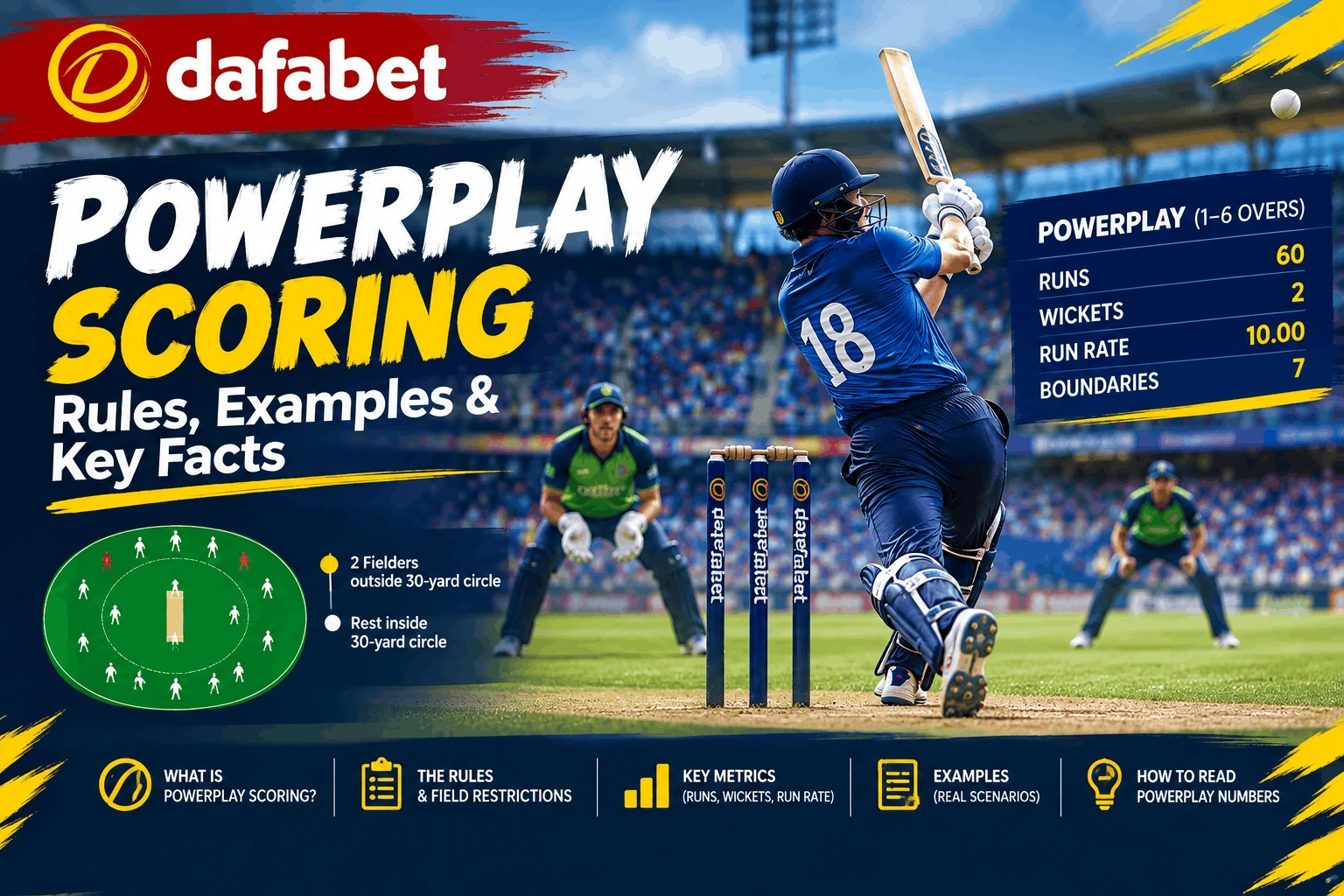
The fielding restrictions. Two fielders outside the 30-yard circle. The rest of the fielders stay inside.
The impact. The batting side faces fewer deep fielders. The gaps open. The boundaries come easier. The bowling side attacks. The field is up. The catches come into play.
ODI cricket. The first powerplay runs from overs 1 to 6. The field restrictions apply. A second powerplay used to exist in ODI cricket. The current rules simplify the format.
T20 cricket. The first six overs are the powerplay. The field restrictions apply. After over six, the field spreads. The bowling side can set the deep field.
The rules matter for the phase. The batting side knows the field. The bowling side knows the risks. The phase becomes a battle. Boundaries against wickets.
A Worked Example
Take a team in a T20 match. Here is how the powerplay builds.
Over one. The opener hits two fours. The score is 10 for 0.
Over two. A wicket falls. The score is 14 for 1.
Over three. The new batter hits a six. The score is 24 for 1.
Over four. The opener hits three fours. The score is 40 for 1.
Over five. A wicket falls. The score is 45 for 2.
Over six. The batter hits two sixes. The score is 60 for 2.
The powerplay score is 60 for 2. The run rate is 10.00. The batting side scored 60 in six overs. The bowling side took two wickets.
That is a strong powerplay. The batting side set the platform. The run rate sits at ten. The wickets fell, but the score climbed.
Now take a different team. The powerplay score is 35 for 3. The run rate is 5.83. The batting side scored 35. The bowling side took three wickets.
That is a poor powerplay. The batting side fell behind. The run rate sits under six. The wickets fell early. The middle order faces the rebuild.
The two phases show the range. The first team has the platform. The second team faces the rebuild. The powerplay scoring captures the difference.
Explore More: Dafabet-Dafabet Cricket Betting: The Wise Option For Indian Cricket Punters
What a High Powerplay Score Tells You
A high powerplay score means the batting side used the field restrictions. Boundaries. Quick runs. The platform for the innings.
The openers attack from the first ball. They target the gaps. They clear the infield. The run rate climbs. The score climbs.
Player performance is tied to this in T20 cricket. A strong powerplay sets up the innings. The middle order can build. The finishers can attack. The total climbs.
In ODI cricket, the powerplay score matters through the innings. A strong start sets the platform. The middle overs rotate the strike. The death overs finish the job.
The high score also puts the bowling side under pressure. The captain spreads the field. The bowling plans shift. The wickets become harder to take.
What a Low Powerplay Score Tells You
A low powerplay score means the bowling side dominated. Wickets. Dot balls. The batting side fell behind
The openers struggle. The ball moves. The fielders stay up. The catches come into play. The run rate stays low. The wickets fall.
This is not always a disaster. A team can rebuild. A partnership in the middle overs can recover the innings. The low powerplay score forces the rebuild.
The context matters. A low score on a seaming pitch may be expected. A low score on a flat pitch is a problem.
The role shapes the expectation. A strong batting side with a low powerplay score has underperformed. A weaker side with a low score may be performing to expectation.
What Powerplay Scoring Misses
Powerplay scoring does not tell the whole story. Here is what the number leaves out.
The rest of the innings. A team can score low in the powerplay and recover. A team can score high and collapse. The statistic captures the first six overs. The rest of the innings decides the match.
The conditions. A powerplay score on a seaming pitch reads differently from the same score on a flat pitch. The statistic does not adjust for the surface.
The opposition quality. A powerplay score against a strong attack counts the same as one against a weak attack.
The match situation. A powerplay score in a losing cause counts the same as one in a winning cause.
Match analysis uses powerplay scoring as one input. Not the only one. The statistic is a starting point. The rest of the innings completes the picture.
The limits do not make the statistic useless. They define what it can and cannot do. The powerplay scoring tells you about the start. It does not tell you about the finish. Both matter. The reader needs both.
Powerplay Scoring Across Formats
The statistic varies by format.
ODI cricket. Powerplay scores are usually higher. 50-over matches give the openers time. The field restrictions apply for six overs. Powerplay scores in the 40 to 60 range are common. Elite teams score above 60.
T20 cricket. Powerplay scores vary. The format rewards aggression. The openers attack from the first ball. Powerplay scores in the 45 to 60 range are common. Elite teams score above 60.
Test cricket. No powerplay. The format does not have the phase.
The difference matters for interpretation. A 50-run powerplay in ODI cricket is standard. The same score in T20 cricket is strong. The format shapes the number.
The Modern Game: Powerplay Strategy
Modern cricket has changed the powerplay approach. Teams plan the phase.
The openers. The batting side picks openers who attack. The role is to score quickly. The powerplay is the time to capitalize.
The bowling plans. The bowling side targets wickets. The field is up. The catches come into play. The bowlers attack the stumps.
The match-ups. The captain plans the bowling match-ups. A spinner against a right-hander. A fast bowler against the openers. The phase becomes a tactical battle.
The data. Teams use data to plan the phase. The scoring zones. The bowler match-ups. The field placements.
The powerplay strategy has evolved. The phase is no longer a warm-up. It is a planned assault.
How to Read Powerplay Numbers
The benchmarks shift by format. In ODI cricket, a powerplay score above 60 is excellent. Between 50 and 60 is strong. Between 40 and 50 is average. Below 40 is a concern.
In T20 cricket, a powerplay score above 60 is excellent. Between 50 and 60 is strong. Between 40 and 50 is average. Below 40 is a concern.
The wickets matter too. A powerplay score of 60 for 0 is better than 60 for 3. The wickets lost shape the innings. The middle order faces the pressure.
These ranges are guides. They shift with eras. They shift with pitches. The modern game has higher scoring rates. The powerplay numbers reflect that.
Powerplay Scoring vs Middle Overs Scoring
The two phases have different roles. The comparison clarifies the innings structure.
Powerplay scoring. Overs 1 to 6. Field restrictions. Boundaries. Wickets. The phase sets the platform.
Middle overs scoring. Overs 7 to 15 in ODI cricket. Overs 7 to 15 in T20 cricket. The field spreads. The strike rotation. The partnerships build.
The powerplay produces the boundaries. The middle overs produce the rotation. The death overs produce the finish. The three phases structure the innings.
The powerplay scoring sets the tone. A strong powerplay gives the middle order freedom. A weak powerplay forces the rebuild. The phase shapes the innings.
The middle overs scoring builds the total. The powerplay provides the start. The two phases work together.
When a commentator mentions powerplay scoring, the context is the first six overs. When the context is the innings build, the statistic is the middle overs scoring. The two are not interchangeable.
The Bottom Line: A Statistic Worth Understanding
Powerplay scoring explained is simple. The runs, wickets, and run rate in the first six overs. The statistic measures the start. It tells you how the batting side used the field restrictions.
The rules matter. Two fielders outside the circle. The phase length. The batting side attacks. The bowling side attacks.
The limits matter too. Powerplay scoring does not measure the rest of the innings. It does not capture the conditions. The statistic is one input among many. The modern game reads it alongside the middle overs and the death overs.
Powerplay scoring in cricket has grown from a phase detail to a core metric. It defines the modern start. Understanding how powerplay scoring works is the key to reading the innings structure.