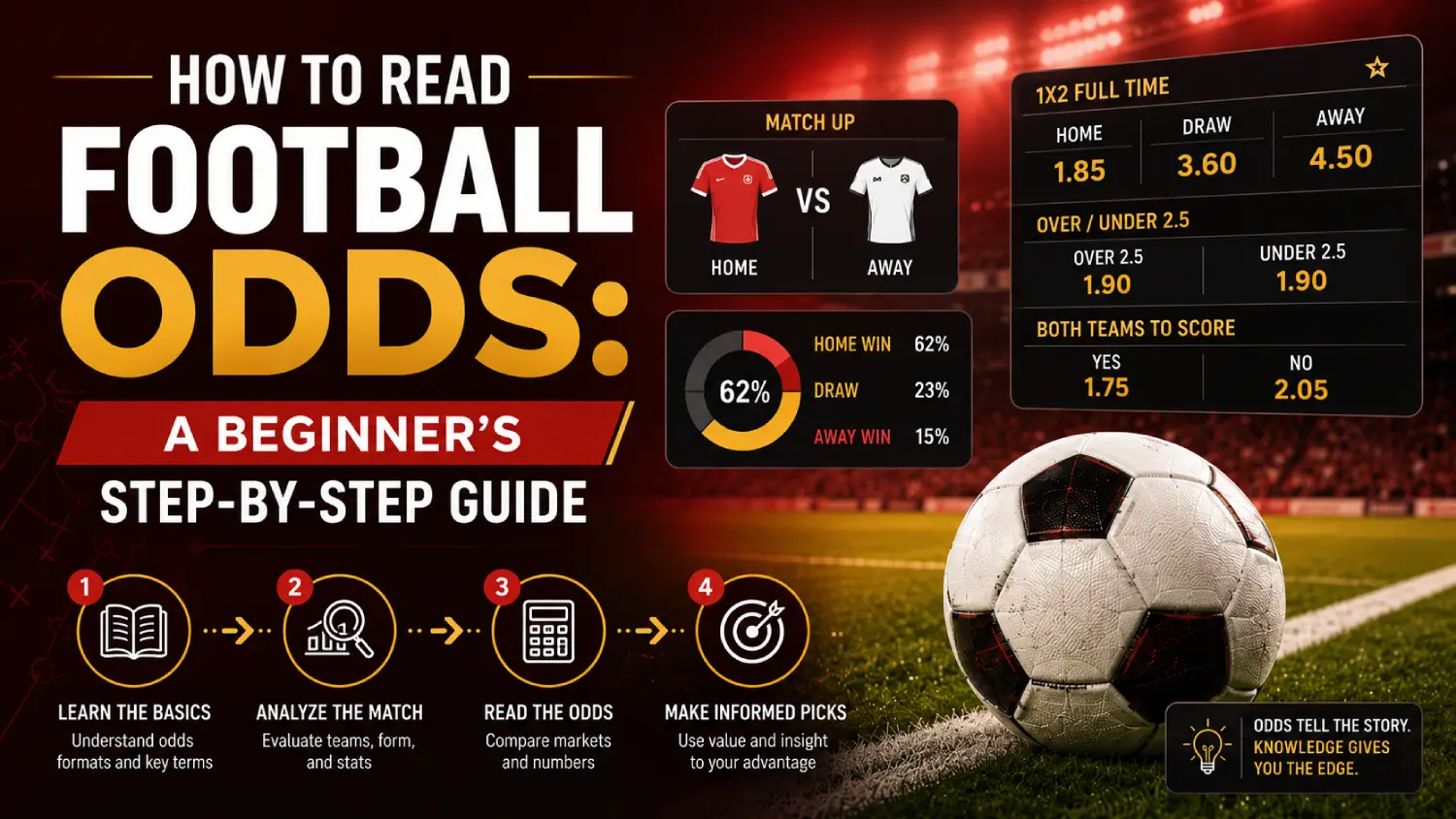

Football odds sit behind every match preview, every prediction, and every betting market you see. Yet most people glance at the numbers without really understanding what they mean — how they’re built, what they reveal about probability, and where the genuine value hides.
This is a complete, ground-up guide. By the end you’ll be able to read football odds in any format, convert them into probability in your head, spot the bookmaker’s margin, compare prices to find the best football odds today, and understand the major markets you’ll bet across — whether you’re following the Premier League, La Liga, the Champions League, or the Indian Super League.

Quick note: This guide is educational. Football betting carries real financial risk, betting laws vary by state in India, and no system guarantees profit. Read the responsible-play section before you stake anything.
Part 1 — What Football Odds Actually Are
At their core, football betting odds do two jobs at the same time:
- They express probability. Odds are a bookmaker’s estimate of how likely an outcome is.
- They set the payout. Odds tell you how much you stand to win relative to your stake.
These two things are linked. A likely outcome (a top club at home against a relegation side) carries short odds — a small number, a small payout. An unlikely outcome (the underdog winning away) carries long odds — a big number, a big payout.
When you understand that odds are just probability wearing a price tag, everything else becomes easier.
Where odds come from
Bookmakers don’t pick odds at random. A typical price is built from:
- Statistical models using team strength ratings, recent form, and expected goals (xG).
- Situational factors — home advantage, fixture congestion, injuries, suspensions, weather, and motivation.
- Market money — how much is being staked on each outcome, which nudges prices to balance the book.
The opening price reflects the model. The price at kickoff reflects the model plus everything the market has learned since.
Part 2 — Reading Odds in Every Format
Football odds appear in three formats. You’ll mostly see decimal in India and Europe, but it pays to recognise all three.
Decimal odds (the standard)
Decimal odds tell you your total return per unit staked — profit and stake combined.
Total Return = Stake × Decimal Odds Profit = Stake × (Decimal Odds − 1)
| Decimal Odds | ₹100 Stake Returns | Profit |
|---|---|---|
|
1.50 |
₹150 |
₹50 |
|
2.00 |
₹200 |
₹100 |
|
3.40 |
₹340 |
₹240 |
|
6.00 |
₹600 |
₹500 |
Simple rule: 2.00 is even money (you double up). Below 2.00 is a favourite; above 2.00 is an underdog.
Fractional odds (UK style)
Written as 5/2, fractional odds show profit only, relative to the stake.
- 5/2 → win ₹5 for every ₹2 staked → ₹250 profit on ₹100, plus your stake back.
- 1/2 → win ₹1 for every ₹2 staked → an odds-on favourite.
To convert to decimal: (numerator ÷ denominator) + 1. So 5/2 = (5 ÷ 2) + 1 = 3.50.
American odds (US style)
Shown with a + or − sign:
- +250 → profit of 250 on a 100 stake (an underdog).
- −200 → you must stake 200 to win 100 (a favourite).
Most apps let you toggle formats in settings, so pick the one you find most natural and stick to it.
Part 3 — Turning Odds Into Probability (The Most Important Skill)
This single calculation separates casual bettors from sharp ones. Convert any decimal odds into an implied probability:
Implied Probability (%) = (1 ÷ Decimal Odds) × 100
| Decimal Odds | Implied Probability |
|---|---|
|
1.50 |
66.7% |
|
2.00 |
50.0% |
|
3.00 |
33.3% |
|
4.50 |
22.2% |
|
6.00 |
16.7% |
Why does this matter? Because betting value comes from comparing the implied probability to your own estimate. If you genuinely believe a team has a 50% chance of winning, but the odds imply only 40% (odds of 2.50), the price is generous — that’s value. If the odds imply 60% (odds of 1.67), the price is short and you’d be overpaying.
You don’t beat football odds by predicting winners. You beat them by finding prices that are wrong relative to true probability.
Part 4 — The Bookmaker’s Margin (The Overround)
Here’s something most beginners miss. Add up the implied probabilities of every outcome in a match and you’ll get more than 100%.
Take a sample three-way market:
| Outcome | Odds | Implied Probability |
|---|---|---|
|
Home win |
2.10 |
47.6% |
|
Draw |
3.50 |
28.6% |
|
Away win |
3.60 |
27.8% |
|
Total |
104.0% |
That extra 4.0% is the bookmaker’s built-in margin — the overround or “vig.” It’s how the house guarantees an edge across all outcomes.
Why this matters for you:
- A lower margin means better value. A book running at 102% is far friendlier than one at 108%.
- Margins vary hugely by market. Match Result markets are tight and competitive; exotic markets like Correct Score carry fat margins.
- Comparing margins, not just headline odds, is the smartest habit you can build.
To estimate a “fair” price with the margin stripped out, divide the implied probability by the total. In the example above, the home win’s true implied chance is roughly 47.6% ÷ 104% ≈ 45.8%, suggesting fair odds nearer 2.18.
Part 5 — The Major Football Betting Markets
Football odds extend far beyond picking a winner. Here are the markets you’ll meet most often.
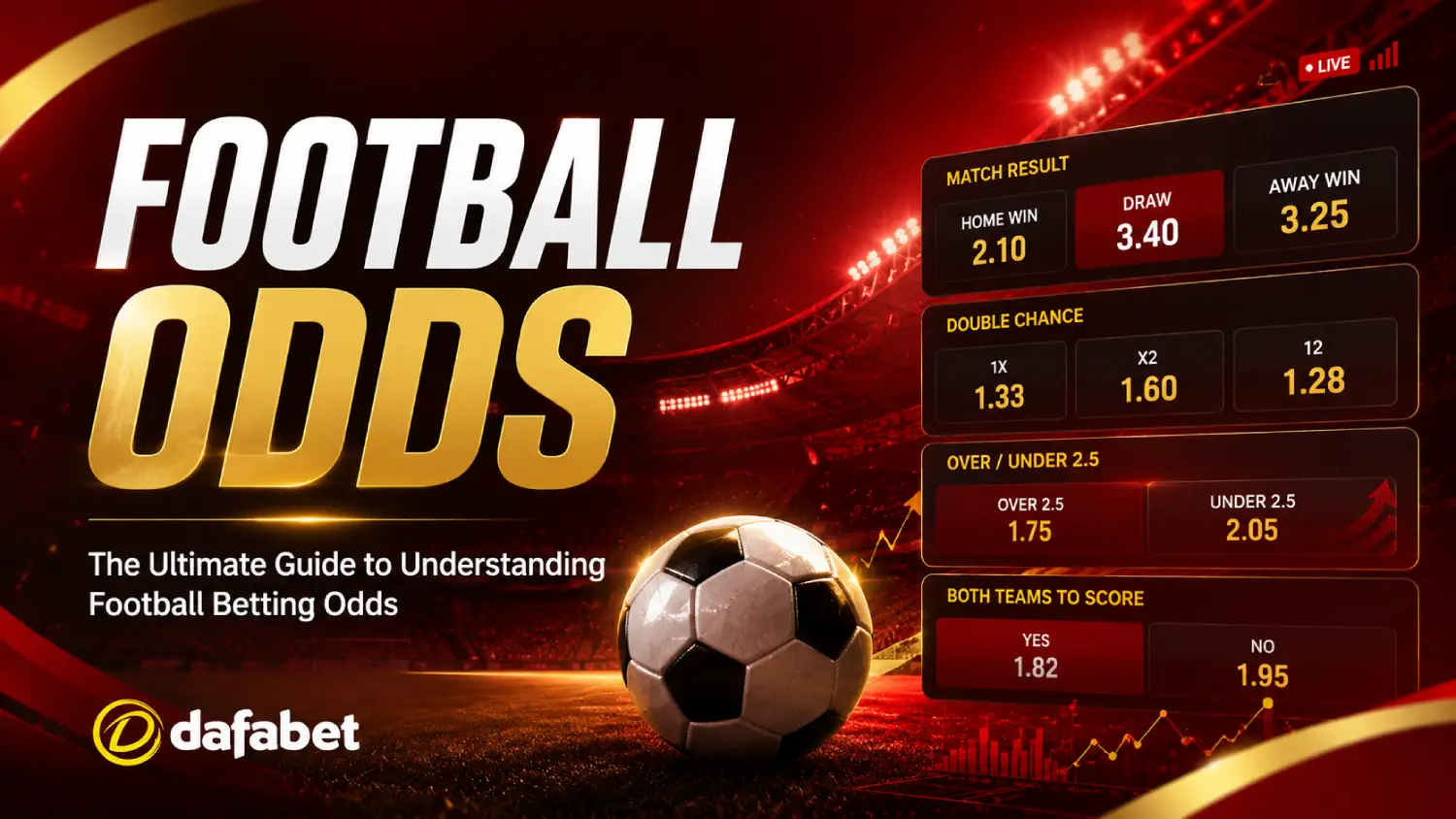
Match Result (1X2)
The classic three-way market: home win (1), draw (X), or away win (2). Tight margins and the most liquid market in football.
Double Chance
Covers two of the three results — e.g. “home win or draw.” Higher chance of landing, but much shorter odds. A lower-variance option.
Over/Under Goals
Will total goals finish above or below a set line, usually 2.5? Ignores who wins entirely and focuses purely on goal volume. Great for matches where you have a read on tempo but not the result.
Both Teams to Score (BTTS)
A simple yes/no on whether both sides find the net. Popular because it stays alive regardless of the scoreline’s direction.
Correct Score
Predict the exact final score. High odds because it’s hard — and a high-margin market, so treat it as entertainment rather than value.
Asian Handicap
Removes the draw by giving one team a virtual head start (e.g. −1.5 goals). Splits stakes across handicap lines and tends to carry tighter margins, which is why experienced bettors favour it.
Player & Prop Markets
Anytime goalscorer, total cards, total corners, and similar. Fun and specific, but margins are usually wide.
Part 6 — How to Find the Best Football Odds Today
The same match is priced differently across sources, and those gaps compound over hundreds of bets. Here’s how sharp bettors hunt for the best football odds today:
- Always compare. A team at 2.00 in one place and 2.15 in another is a 7.5% difference in payout on an identical bet. Never accept the first price you see.
- Track line movement. Odds shift as team news drops and money flows. A price that drifts longer may signal value; one that shortens fast reflects sharp money.
- Bet into your knowledge. Your edge is the league you watch every week — not a stranger’s tip. Local knowledge of ISL squads or lower-division form is genuinely valuable.
- Mind the margin. Two books can show 2.00 on a favourite while one runs a 102% book and the other 107%. The tighter book is the better long-term home for your stakes.
- Catch early lines. The sharpest value often appears the moment markets open, before the price settles around true probability.
- Specialise. Following one or two leagues deeply beats spreading thin across competitions you barely watch.
Part 7 — Why Football Odds Move
Odds are living numbers. They shift in response to:
- Team news — a key striker ruled out can swing a price within minutes.
- Weather — heavy rain or wind that favours defensive, low-scoring play.
- Betting volume — heavy money on one side forces the price shorter to balance the book.
- Form and motivation — a dead rubber late in the season behaves nothing like a relegation six-pointer.
- Lineups at confirmation — roughly an hour before kickoff, when starting XIs are confirmed, prices often make their final adjustment.
Watching how a price moves tells you what the market has learned since the line opened.
Part 8 — Common Mistakes to Avoid
- Chasing losses. Raising stakes to recover is the fastest route to a bigger hole.
- Betting favourites blindly. Short odds are not “safe” — they’re just expensive. Value can sit on either side.
- Ignoring the margin. Two identical-looking prices can offer very different real value once the overround is accounted for.
- Overbetting accumulators. Stacking many selections multiplies the margin against you on every leg. The headline payout looks huge precisely because it’s unlikely.
- Confusing knowledge with edge. Knowing football and beating the market are different skills. The market is your real opponent, and it’s very efficient.
Part 9 — Responsible Play
Football odds are a tool for understanding probability, not a route to guaranteed income. The bookmaker’s margin means the house holds a structural edge over time, and most people who bet lose money in the long run.
Keep these principles non-negotiable:
- Only stake what you can comfortably afford to lose. Treat it as the cost of entertainment, never as income.
- Set a fixed budget before you start and stop when it’s gone.
- Never chase losses. Recovery betting is where small problems become large ones.
- Avoid betting when emotional — stressed, bored, or after a drink.
- Take regular breaks and keep betting a small part of your enjoyment of the game.
Betting laws in India vary by state, so check what applies where you live. If gambling stops being fun or starts affecting your finances, relationships, or mood, free and confidential support is available through responsible-gambling helplines. Reaching out early is a sign of strength, not failure.
Football Odds Glossary
| Term | Meaning |
|---|---|
|
Decimal odds |
Total return per unit staked (stake + profit). |
|
Fractional odds |
Profit relative to stake, shown as a fraction. |
|
Implied probability |
The chance an outcome has, derived from its odds. |
|
Overround / Vig |
The bookmaker’s built-in margin above 100%. |
|
Short odds |
Low numbers; a likely outcome, small payout. |
|
Long odds |
High numbers; an unlikely outcome, big payout. |
|
Drift |
Odds lengthening over time (outcome seen as less likely). |
|
Steam |
Odds shortening fast on heavy money. |
|
Value |
A price longer than the true probability warrants. |
|
Accumulator |
Multiple selections combined into one bet. |
Frequently Asked Questions
What do football odds of 2.00 mean? Odds of 2.00 are “even money” — an implied probability of 50%. A ₹100 stake returns ₹200 (₹100 profit). Anything below 2.00 is a favourite; anything above is an underdog.
How do I convert football odds to a percentage chance? Divide 1 by the decimal odds and multiply by 100. So 2.50 odds = (1 ÷ 2.50) × 100 = a 40% implied probability.
Why are the same football odds different across sources? Each bookmaker sets its own model, margin, and prices based on the money it takes. That’s exactly why comparing odds helps you find better value on the same match.
What does it mean when football odds move before kickoff? Prices shift in response to team news, injuries, weather, and betting volume. Movement reflects new information the market has absorbed since the line opened.
What are the safest football betting markets? Lower-variance markets like Double Chance land more often but pay less. No market is truly “safe,” since every outcome involves real uncertainty and a built-in margin against you,
Can you make consistent profit from football odds? It’s extremely difficult. The bookmaker’s margin means the house has a long-term edge, and the market is highly efficient. Treat betting as entertainment with a budget, not as an income strategy.
This article is for informational and educational purposes only and does not constitute betting or financial advice. Please gamble responsibly, stay within the laws of your region, and seek support if betting stops being fun.